New Guinea
Maprik Tumbuna Drum New Guinea
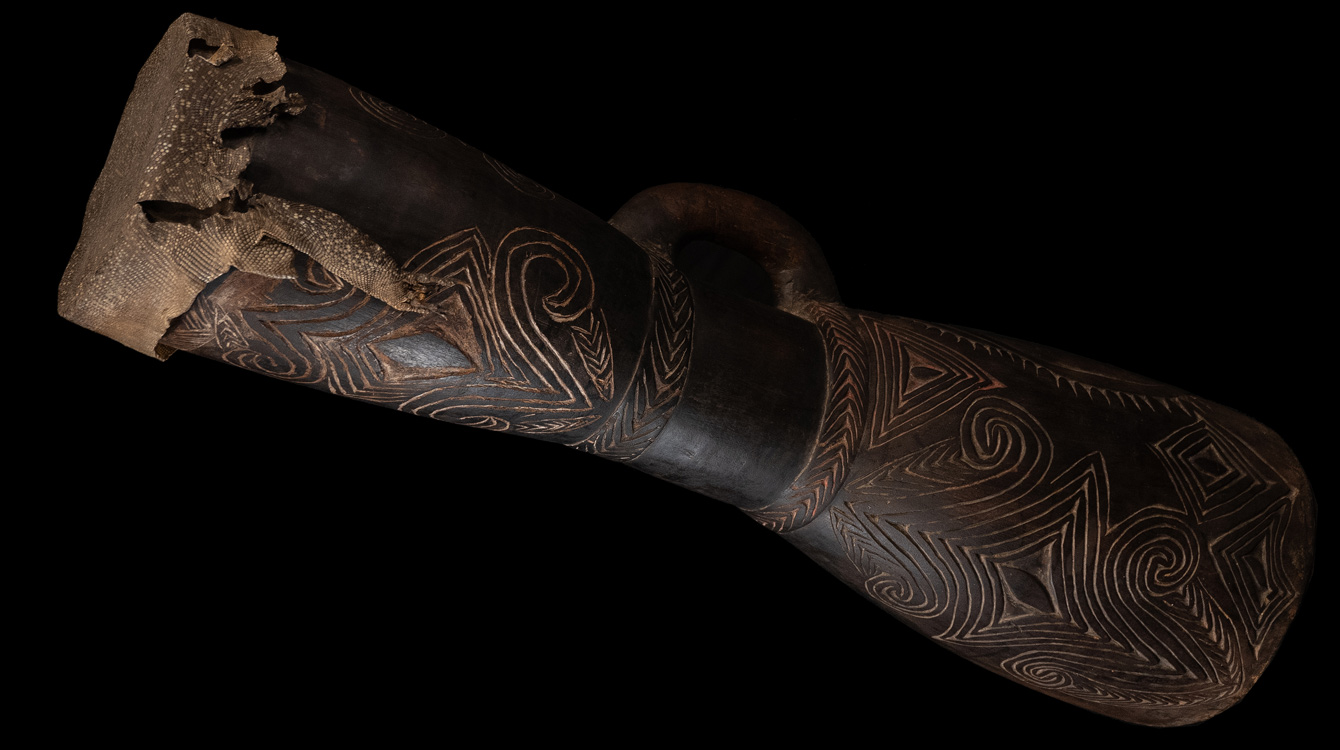
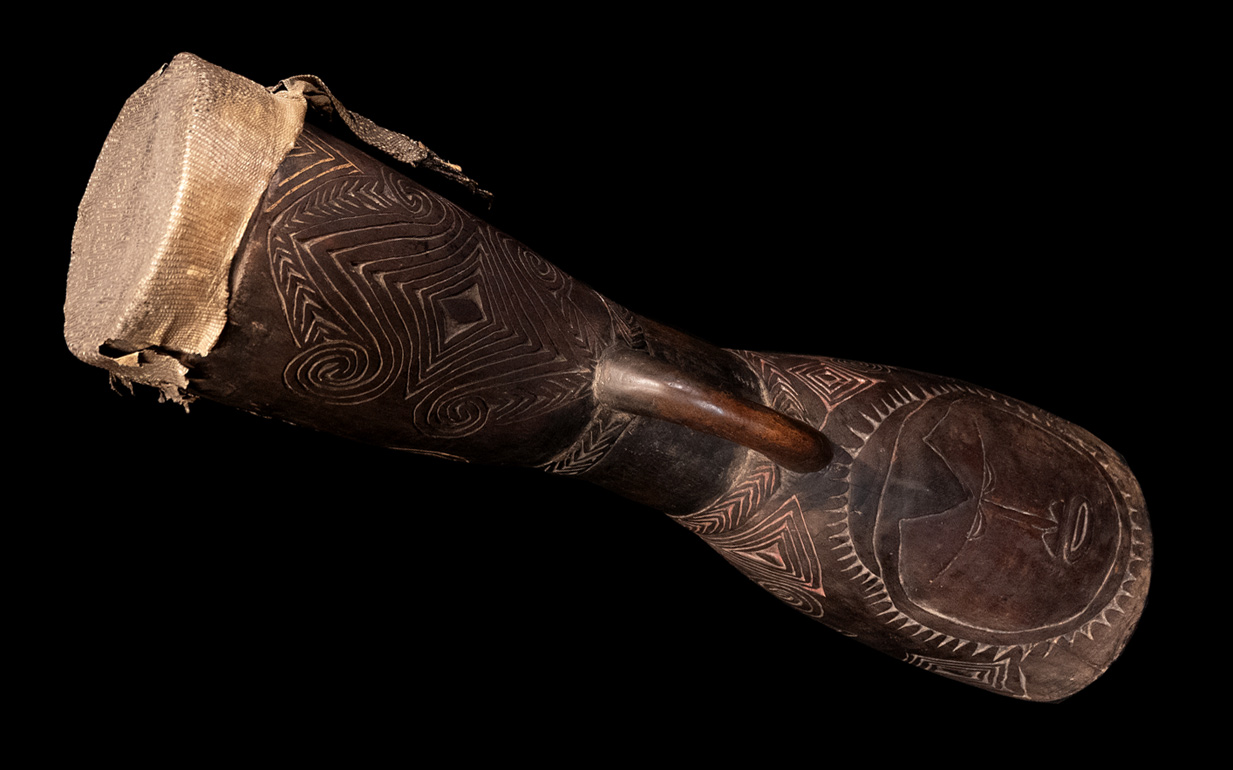
Maprik Tumbuna Drum (Abelam, East Sepik, Papua New Guinea)
The Tumbuna drum belongs to the traditional musical culture of the Abelam of the Maprik area in East Sepik Province, Papua New Guinea. The term tumbuna refers broadly to the ancestral past and to the traditions, stories and knowledge inherited from earlier generations. Within Abelam culture, music, dance and visual art are closely connected with the transmission of this ancestral knowledge.
Tumbuna drums are used particularly during initiation ceremonies, yam festivals and other important communal events. During such performances, drumming accompanies singing and dancing and forms part of the ceremonial presentation of ancestral traditions. The drum is held in one hand while the other hand strikes the lizard-skin membrane. The sound therefore becomes an integral element of collective ritual performance rather than simply musical accompaniment.
The drum is carved from a single piece of wood and follows the characteristic hourglass form of the Abelam Kundu. The central waist is provided with a substantial carved handle, allowing the instrument to be held securely during performance. Traditional drums of this type were shaped with an adze and hollowed by a slow burning process. The wood had to dry gradually in order to reduce the danger of cracking, making the manufacture of a large drum a lengthy process.
The present example is particularly notable for the density and refinement of its incised decoration. Spiral motifs, concentric geometric forms, angular patterns and narrow ornamental bands cover much of the surface and create a continuous visual rhythm around the drum. The decoration is not merely applied to an otherwise neutral surface; it follows the changing proportions of the body and emphasizes the transition between the upper resonating section, the narrow waist and the lower part of the drum.
Spiral and geometric forms are among the characteristic elements of Abelam visual art. Comparable principles of ornamentation occur on ceremonial objects, architectural elements and sculpture, where repeated lines and controlled geometric structures create highly complex surfaces. On the present drum, these motifs transform the functional body of the instrument into a sculptural work whose visual rhythm parallels the rhythmic function of the drum itself.
The instrument also illustrates the close relationship between the musical and visual traditions of the Abelam. The Kundu is simultaneously a functional membranophone and an object carrying the artistic language of its community. Its use during ceremonies associated with initiation, yam cultivation and ancestral traditions places the decorated drum within a wider cultural system in which music, performance, social identity and inherited knowledge are inseparable.
The name Tumbuna therefore has a significance extending beyond the designation of a particular type of drum. It evokes the ancestral past and the continuity of cultural knowledge. In this context, the richly carved surface of the present Kundu can be understood as part of the same cultural world in which ancestral narratives are transmitted through performance, visual representation and ceremonial practice.
Bibliography:
Koch, Gerd: Kultur der Abelam – Die Berliner Maprik-Sammlung.
Maaz, Klaus: Abelam – Die magische Welt der Abelam. Kunst und Kult in Papua-Neuguinea.
Hamson, Michael (ed.): Art of the Abelam. Contributions by Siobhan Campbell, Laurent Granier, Virginia-Lee Webb and Diane Sheehan.
Craig, Barry; Busse, Mark; Eoe, Soroi (2010): Living Spirits with Fixed Abodes – The Masterpieces Exhibition. Papua New Guinea National Museum and Art Gallery.
Fischer, Hans (1958): Schallgeräte in Ozeanien. Sound-producing Instruments in Oceania.