New Guinea
Sepik area Drum New Guinea
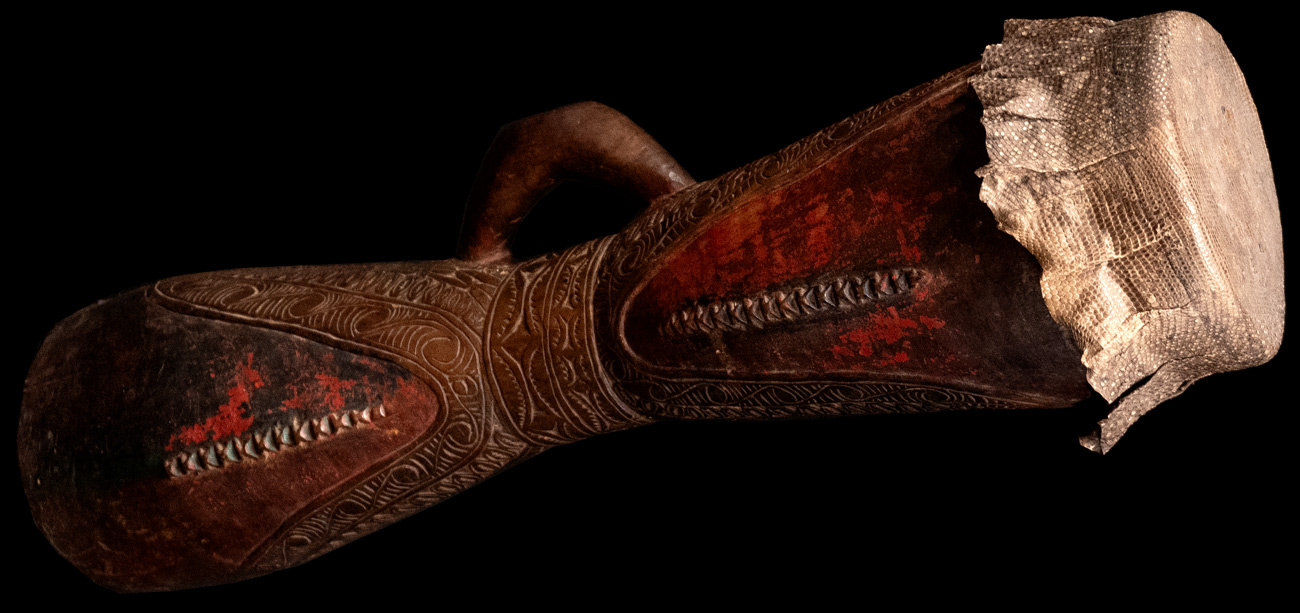
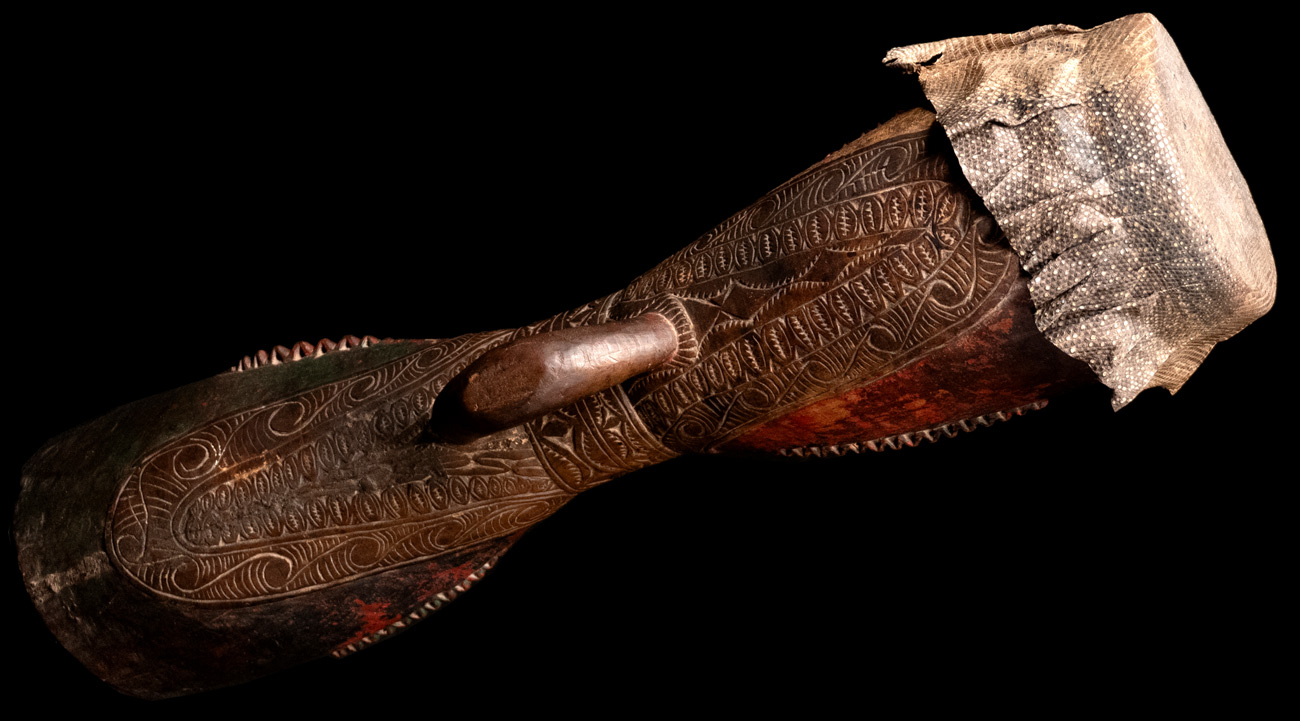
Sepik Area Kundu Drum (Sepik, New Guinea)
The hourglass-shaped Kundu is one of the characteristic hand drums of the Sepik region of New Guinea. Drums are closely associated with ceremonial life and accompany dancing, singing and other important communal events. In traditional performances, the drum can form part of a musical and ritual context in which ancestral traditions and stories are expressed.
The drum is carved from a single piece of wood and hollowed by a combination of controlled burning and carving. The manufacture of such instruments is a lengthy process, as the wood must dry slowly to reduce the danger of cracking. The present example demonstrates the characteristic hourglass profile with a pronounced central waist and an integrated wooden handle.
The instrument is held in one hand while the other hand strikes the lizard-skin drumhead. Traditional Sepik drums may be fitted with small pellets of beeswax on the membrane. These alter the vibration of the skin and can be used to refine the sound. The tension and pitch of the drumhead can also be adjusted by warming it over a fire.
The present drum is particularly notable for its carefully incised ornament. The elongated geometric and curvilinear patterns follow the contours of the body and emphasize the transition between the two expanded ends and the narrow waist. The decoration demonstrates the close relationship between musical instruments and the wider tradition of woodcarving in the Sepik region, where functional objects frequently become carriers of complex visual expression.
The combination of sculptural form, carved ornament and musical function makes the Kundu more than a purely functional instrument. Within the ceremonial life of the Sepik region, drumming is closely connected with dance, song and the transmission of ancestral knowledge, linking the sound of the instrument with the social and spiritual traditions of the community.
Bibliography:
Ammann, Raymond (1997): Le rythme Kanak. Cahiers de musiques traditionnelles.
Bateson, Gregory (1936): “Music in New Guinea.” The Eagle 48.
Bogner, Piet (1984): Traditionelle Musikinstrumente aus Neuguinea. München: Gesellschaft zur Erforschung der Naturvölker.
Chauvet, Stephen (1930): Les arts indigènes en Nouvelle-Guinée.
Collaer, Paul (1965): Musikgeschichte in Bildern – Ozeanien. Musikethnologie 1. Leipzig.
Craig, Barry (ed.) (2011): Living Spirits with Fixed Abodes. Honolulu: University of Hawai'i Press.
Crawley, A. E. (1931): Dress, Drinks, and Drums: Further Studies of Savages and Sex. London: Methuen.
Fischer, Hans (1958): Schallgeräte in Ozeanien. Sound-producing Instruments in Oceania.
Friede, John (2005): New Guinea Art – Masterpieces of the Jolika Collection from Marcia and John Friede.
Gourlay, Kenneth (1975): Sound-Producing Instruments in Traditional Society.
Graf, Walter (1950): Die musikwissenschaftlichen Phonogramme Rudolf Pöchs von der Nordküste Neuguineas.
Kelm, Heinz (1966): Kunst vom Sepik.
Kunst, Jaap (1931): A Study on Papua Music.
Martinez-Jacquet, Elena: Invocando a los espíritus: instrumentos musicales de Indonesia y Oceanía en la colección Helena Folch.
Neuhauss, Richard (1911): Deutsch-Neu-Guinea. Vols. I–III. Berlin: Reimer.
Niles, Don (2006): “Drums.” In P. Peltier and F. Morin (eds.), Shadows of New Guinea: Art from the Great Island of Oceania in the Barbier-Mueller Collections.
Peltier, Philippe; Schindlbeck, Markus; Kaufmann, Christian (eds.) (2015): Sepik. Arts de Papouasie Nouvelle-Guinée. Paris: Skira / Musée du quai Branly.
Reche, Otto (1913): “Der Kaiserin-Augusta-Fluss.” In Georg Thilenius (ed.), Ergebnisse der Südsee-Expedition 1908–1910.
Spearritt, Gordon (1982): “The Pairing of Musicians and Instruments in Iatmul Society.” Yearbook for Traditional Music 14
Wirz, Paul (1959): Kunst und Kult des Sepik-Gebietes (Neu-Guinea). Amsterdam: Koninklijk Instituut voor de Tropen.