New Guinea
Papuan Gulf drum New Guinea
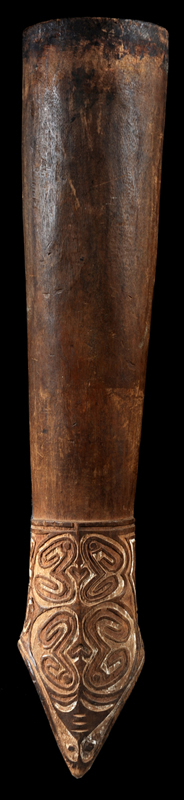
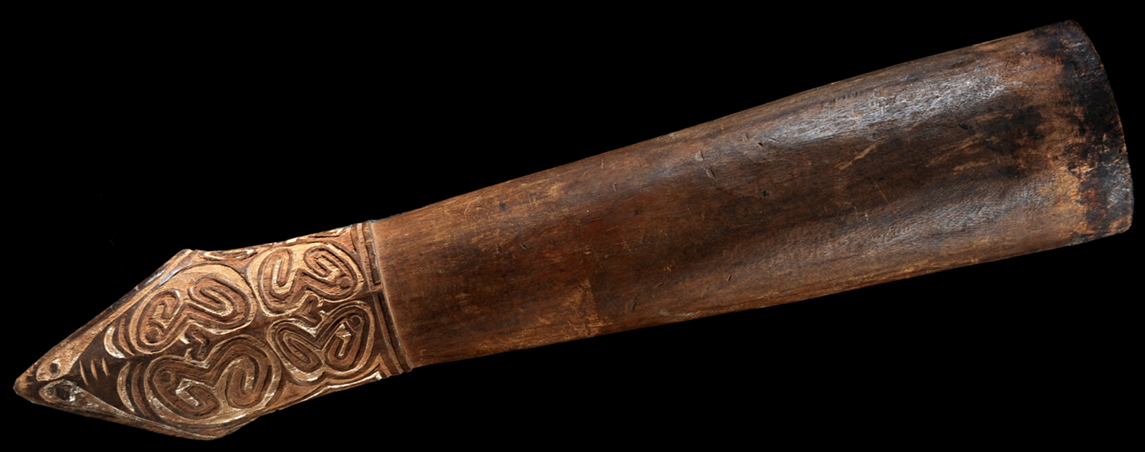
Papuan Gulf Drum (Papuan Gulf, New Guinea)
This drum comes from the Papuan Gulf of New Guinea, a region renowned for its distinctive traditions of carved wooden art and ceremonial objects. Musical instruments in this cultural area were closely connected with dance, ritual performance and the representation of ancestral and spiritual beings.
The present drum has a relatively restrained elongated body, while the lower section is richly carved with interconnected spiral motifs and stylized ancestral faces. The contrast between the plain upper body and the highly ornamented lower section gives the instrument a distinctive visual character. The carved patterns are closely related to the wider decorative vocabulary of the Papuan Gulf and have parallels in other ceremonial objects, charms and men's bark belts.
The open lower end is shaped in the form of a mouth or jaw. In the literature this feature has variously been described as a fish mouth, shark mouth or crocodile mouth. The form has also been interpreted in relation to the idea of the drum as a “speaking” instrument, emphasizing the active role of sound within ceremonial performance.
According to Robert Welsch, drums in the Papuan Gulf could be marked with clan emblems and imagery representing particular spirits associated with human activities. The carved faces and spiral motifs of the present example should therefore be understood within a broader artistic tradition in which musical instruments could carry social, ancestral and spiritual meanings.
The mouth-shaped lower opening may possibly be connected with the pairama initiation ceremonies of the Elema and neighbouring peoples. In these ceremonies, the primordial being known as Kaiamunu or Kopiravi, described as a man-eating ancestral creature, occupies an important position. The precise meaning of the imagery on this individual drum, however, cannot be established with certainty.
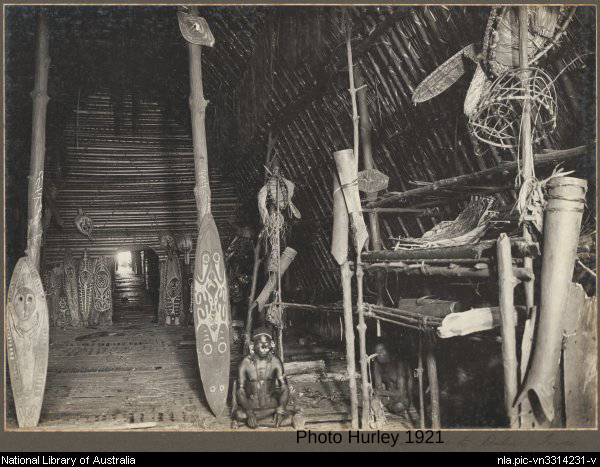
An important historical visual reference is provided by a photograph taken by James Francis Hurley in 1921. The photograph, preserved by the National Library of Australia, shows the interior of a ceremonial house in the Papuan Gulf region with a number of carved wooden objects. Its documentation provides valuable evidence for the wider ceremonial environment in which elaborately carved objects of this type were kept and used.
Bibliography:
Williams, F. E. (1940): Drama of Orokolo. The Social and Ceremonial Life of the Elema.
Wirz, Paul: Beiträge zur Ethnographie des Papua-Golfes, Britisch-Neuguinea.
Welsch, Robert L.; Webb, Virginia-Lee; Haraha, Sebastian (2006): Coaxing the Spirits to Dance: Art and Society in the Papuan Gulf of New Guinea.
Newton, Douglas (1961): Art Styles of the Papuan Gulf. The Museum of Primitive Art, New York.
Hamson, Michael (2010): Red Eye of the Sun: The Art of the Papuan Gulf.
Lewis, Albert Buell (1925): Decorative Art of New Guinea.
Chauvet, Stephen (1930): Les arts indigènes en Nouvelle-Guinée.
Friede, John (2005): New Guinea Art – Masterpieces of the Jolika Collection from Marcia and John Friede.
Bell, Joshua A.; Beran, Harry; Coupaye, Ludovic (2007): Shadows of New Guinea – Art of the Great Island of Oceania in the Barbier-Mueller Collections.
Martinez-Jacquet, Elena: Invocando a los espíritus: instrumentos musicales de Indonesia y Oceanía en la colección Helena Folch.
Craig, Barry (ed.) (2011): Living Spirits with Fixed Abodes. University of Hawai'i Press.
Kelm, Heinz (1966): Kunst vom Sepik.