New Guinea
Apa Drum | Papuan Gulf | New Guinea
Apa Drum Papuan Gulf(Elema Culture, Orokolo Area, Papua New Guinea)
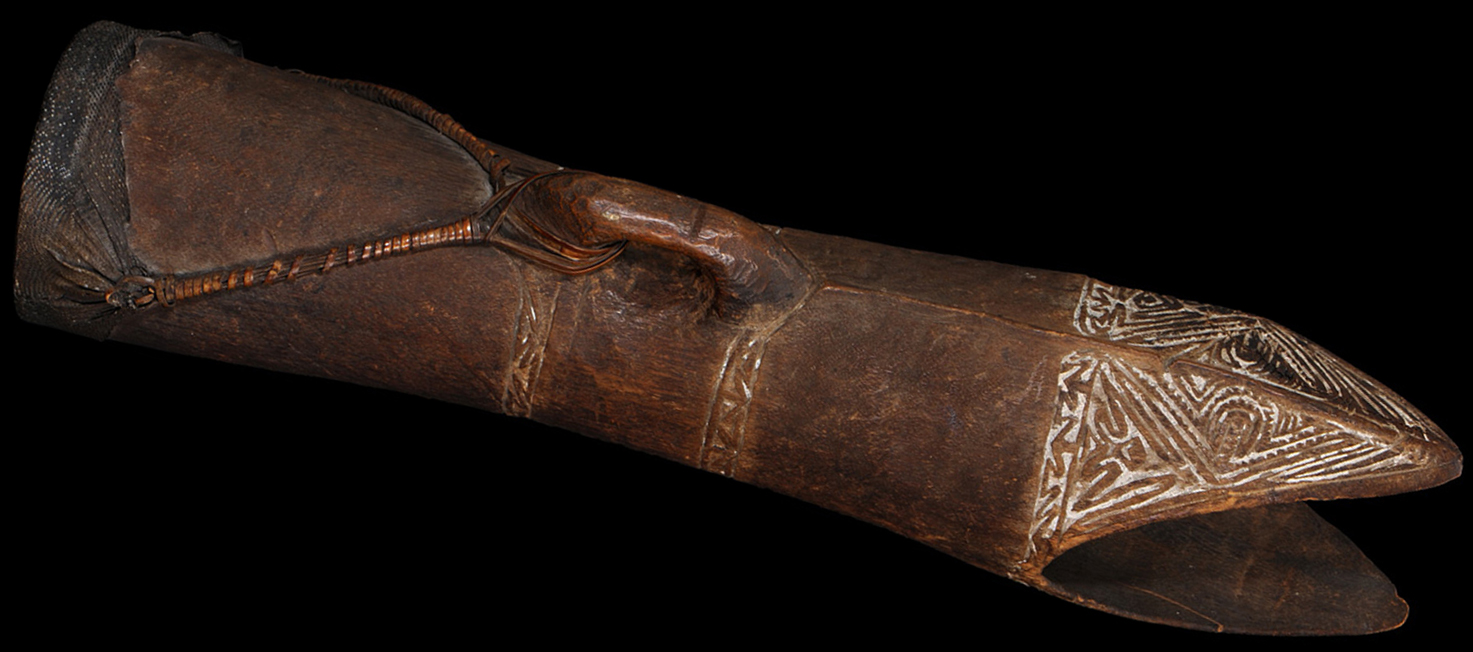
This apa/kundu drum comes from the Orokolo area of the Papuan Gulf and belongs to the distinctive tradition of carved wooden drums associated with the Elema cultural region of southern New Guinea. Drums formed an important part of ceremonial performances in which music, dance, ancestral imagery and ritual activity were closely interconnected.
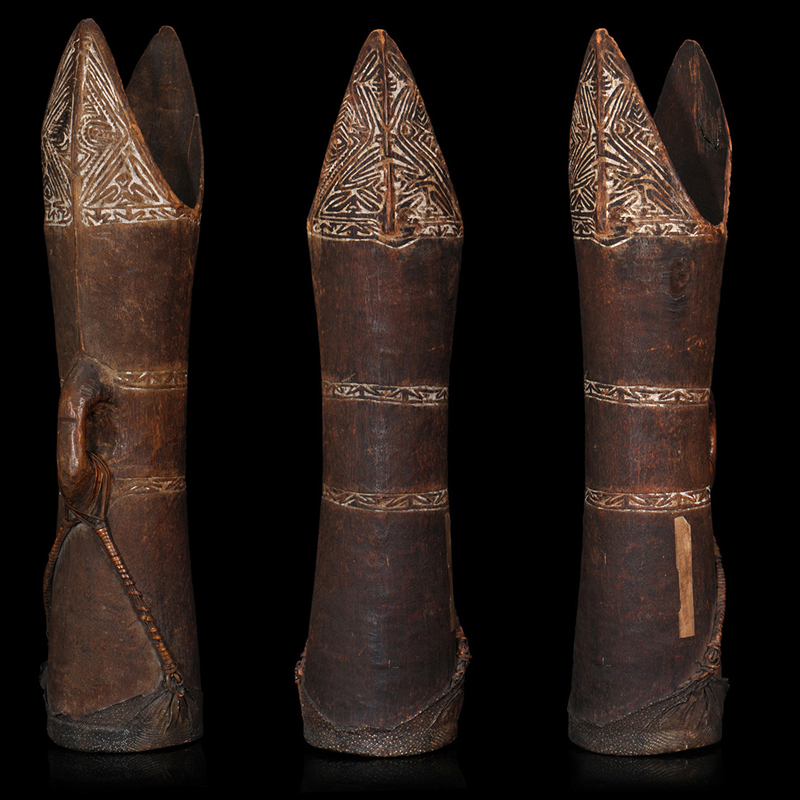
The present drum is particularly notable for its sculptural treatment. Two stylized ancestral spirit faces are carved on the flanged sides of the open, crocodile-like mouth at the lower end of the instrument. The body is further decorated with incised spiral patterns, while the open lower end gives the drum an unusually expressive and almost animate character.
The mouth-shaped opening has been described in the literature variously as a “fish mouth,” “shark mouth” or “crocodile mouth.” Its precise meaning cannot be established with certainty. The form has, however, been associated with the idea of a drum as a “speaking” instrument. The carved faces and other imagery may likewise refer to ancestral or spiritual beings connected with particular communities and ceremonial traditions.
According to Robert Welsch, drums in the Papuan Gulf could be decorated with clan emblems and imagery representing particular spirits who were believed to look after human activities. The spiral motifs found on this drum are part of a wider decorative vocabulary of the region and have parallels in other carved and incised ceremonial objects, charms and men's bark belts.
The drum retains an intact monitor-lizard-skin tympanum. The membrane is held taut by strips of cane anchored to the carved handle. The instrument was played by holding the body with one hand while striking the drumhead with the other. As with other Papuan Gulf drums, the membrane could be warmed when necessary to restore its tension and maintain the desired sound.
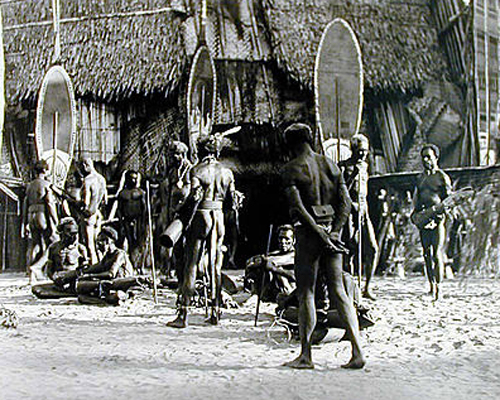
The ceremonial importance of this type of drum is particularly well illustrated by a historical photograph showing an Hevehe performance in the Orokolo area. A drum of the same characteristic type is clearly visible among the ceremonial participants. The photograph therefore provides direct historical evidence for the presence and use of this form of drum within the ceremonial environment of the Elema.
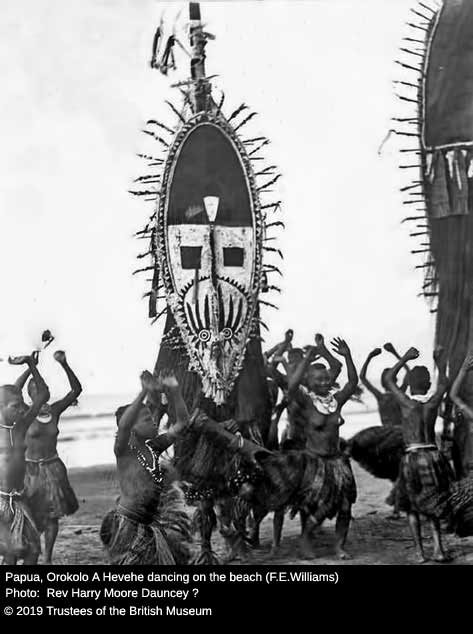
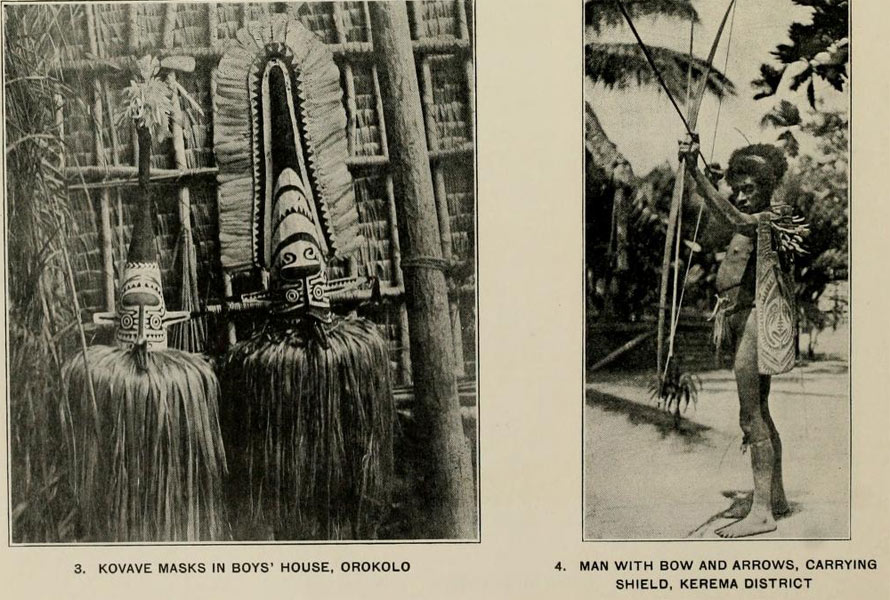
The Hevehe was an extensive ceremonial cycle of the Orokolo and other Elema communities, involving masked performers, elaborate costumes, dance and music. The masks and associated ceremonial regalia represented ancestral and spiritual beings and played an important role in the social and ritual life of the community. Within this setting, the drum was not merely a musical device but formed part of a larger system of visual, acoustic and ceremonial communication.
"Among the Orokolo, the masked hevehe dancers themselves played drums. While women were not allowed into the longhouses, upon emergence from the longhouse, each masked dancer was met by its own group of adoring females who danced with it in the village plaza and down to the beach over a period of a month. Such ceremonial cycles took between one and three decades to complete. Similar forms appeared among groups further to the east as well (Williams 1939:145, 152–55; 1940:357–58; Welsch 2006:11–12, 23)."
Excerpt from: Weiner, James F. and Niles, Don (2015), Songs of the Empty Place – The Memorial Poetry of the Foi of the Southern Highlands Province of Papua New Guinea, p. XXXVI.
The combination of ancestral faces, spiral ornament, the expressive mouth-shaped opening and the surviving lizard-skin membrane makes this drum an especially striking example of Papuan Gulf carving. It demonstrates how an instrument could unite musical function with the representation of ancestral beings and the visual language of ceremonial art.
Bibliography:
Weiner, James F. and Niles, Don (2015): Songs of the Empty Place – The Memorial Poetry of the Foi of the Southern Highlands Province of Papua New Guinea.
Williams, F. E. (1940): Drama of Orokolo. The Social and Ceremonial Life of the Elema.
Wirz, Paul: Beiträge zur Ethnographie des Papua-Golfes, Britisch-Neuguinea.
Welsch, Robert L.; Webb, Virginia-Lee; Haraha, Sebastian (2006): Coaxing the Spirits to Dance: Art and Society in the Papuan Gulf of New Guinea.
Newton, Douglas (1961): Art Styles of the Papuan Gulf. The Museum of Primitive Art, New York.
Hamson, Michael (2010): Red Eye of the Sun: The Art of the Papuan Gulf.
Lewis, A. B. (1925): Decorative Art of New Guinea.
Chauvet, Stephen (1930): Les arts indigènes en Nouvelle-Guinée.
Friede, J. (2005): New Guinea Art – Masterpieces of the Jolika Collection from Marcia and John Friede.
Bell, Joshua A.; Beran, Harry; Coupaye, Ludovic (2007): Shadows of New Guinea – Art of the Great Island of Oceania in the Barbier-Mueller Collections.
Martinez-Jacquet, Elena: Invocando a los espíritus: instrumentos musicales de Indonesia y Oceanía en la colección Helena Folch.
Craig, Barry (ed.) (2011): Living Spirits with Fixed Abodes. University of Hawai'i Press.
Kelm, Heinz (1966): Kunst vom Sepik.