Pre-Contact Asmat Drum (Papua Selatan | South Papua, Indonesia)
The drum occupies a fundamental position within the ceremonial and musical life of the Asmat people of southwestern New Guinea. It is associated not only with musical performance but also with the Asmat understanding of human origins and the relationship between the living and the ancestral world. Drums are played during ceremonies and rituals and accompany a wide range of village songs, both public and private.
According to Asmat origin traditions, the connection between the drum and human life reaches back to the mythical culture hero Fumeripits. After carving wooden figures in order to overcome his loneliness, Fumeripits began to beat a drum beside them. Through the sound of his drumming the figures came to life and became the first Asmat people. The drum is therefore closely connected with the transformation of carved wood into living beings and with the ancestral foundations of Asmat society.
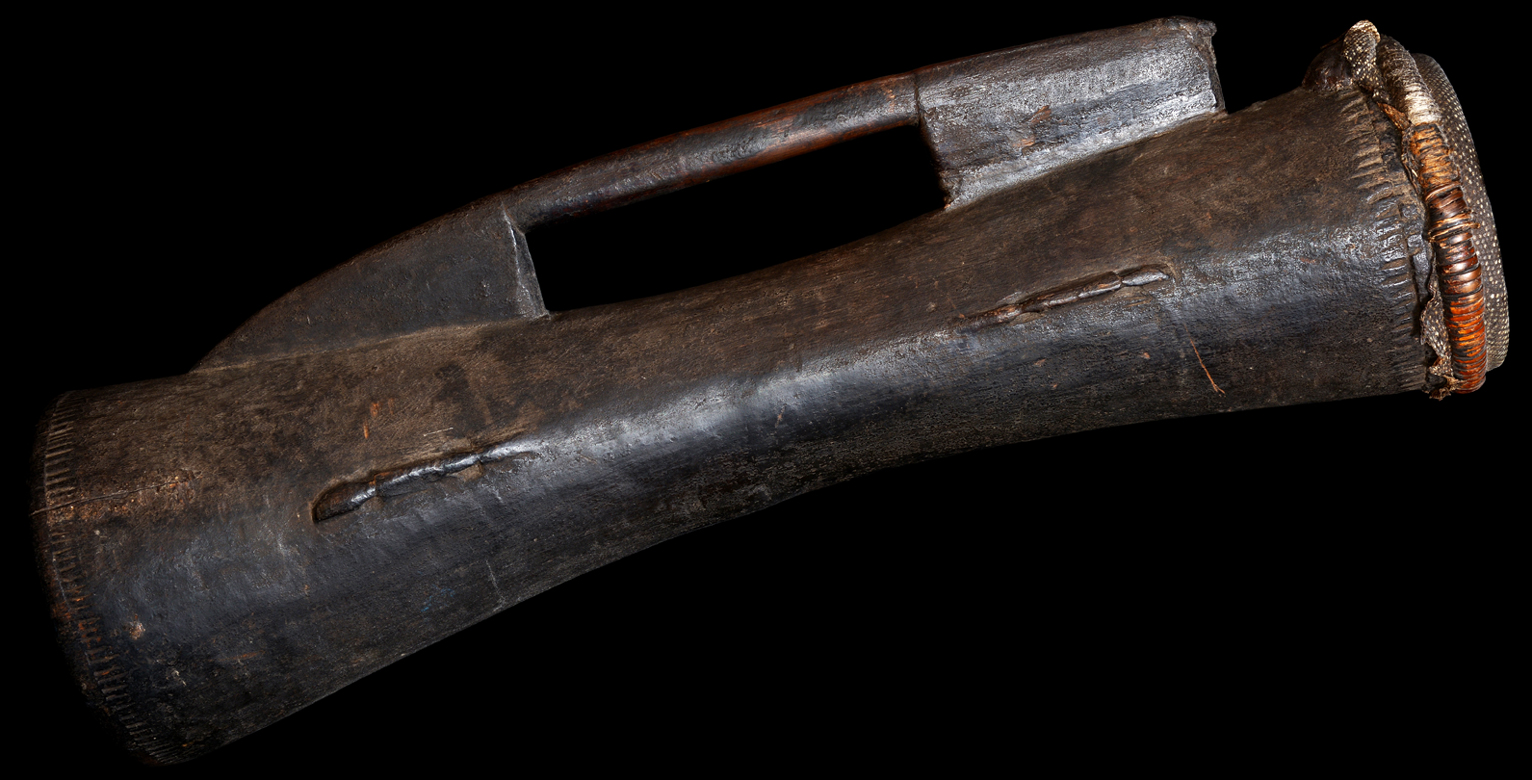
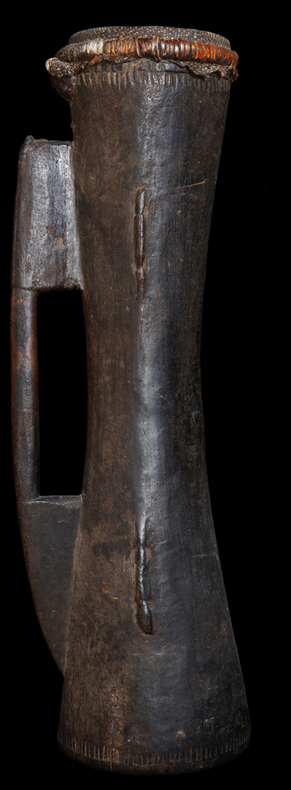
The present example is a particularly early and technically remarkable drum. Its relatively undecorated surface contrasts with the highly developed sculptural forms often associated with Asmat woodcarving. The body was carved and hollowed using traditional tools, and its construction reflects the considerable woodworking skills required to produce a resonating vessel from a single piece of wood. The broad body narrows toward the central section and incorporates a substantial carved handle, allowing the instrument to be held securely during performance.
Asmat drums are traditionally single-headed membranophones. The membrane is stretched over one end of the wooden body and is struck directly by the hand. Their names vary according to local terminology and include em, eme, im, imi, kiendo, and ta'impe. The instrument's sound forms an integral part of collective performance, where rhythmic drumming, singing and movement create a connection between ceremonial participants and the ancestral traditions represented by the ritual.
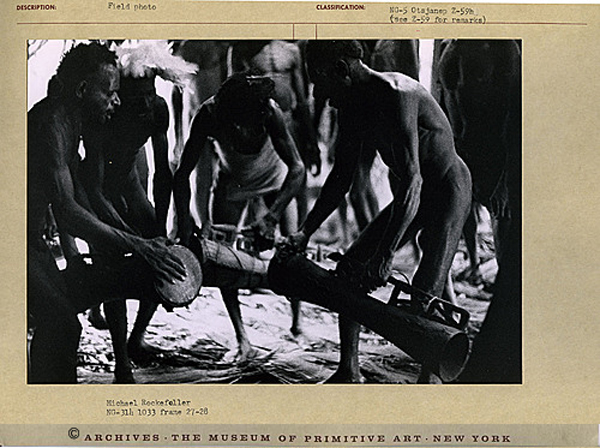
The historical photograph shown with this object provides a visual comparison with the traditional use of Asmat drums. It documents Asmat men performing with drums during a field expedition and illustrates the characteristic manner in which the instrument is held and played.
Source
The Asmat tradition of Fumeripits, the origin of human beings through carved wooden figures, and the fundamental role of drumming in Asmat ceremonial life are discussed in the ethnographic literature on Asmat mythology, ritual and art.
Gerbrands, Adrian A. (ed.), The Asmat of New Guinea: The Journal of Michael Clark Rockefeller. New York: Museum of Primitive Art, 1967.
Gerbrands, Adrian A. (ed.) (1967):
The Asmat of New Guinea: The Journal of Michael Clark Rockefeller. New York: Museum of Primitive Art.
Helferich, Klaus, Jebens, Holger, Nelke, Wolfgang & Winckelmann, Carolina (1995):
Asmat – Mythos und Kunst im Leben mit den Ahnen. Berlin: Museum für Völkerkunde.
Konrad, Gunter & Konrad, Ursula (eds.) (1996):
Asmat – Myth and Ritual: The Inspiration of Art. Erizzo Editrice, Venice.
Schneebaum, Tobias (1990):
Embodied Spirits – Ritual Carvings of the Asmat. Salem: Peabody Museum of Salem.
Smidt, Dirk (ed.) (1993):
Asmat Art: Woodcarvings of Southwest New Guinea. Leiden.