New Guinea
Ramu Sepik Area Drum New Guinea
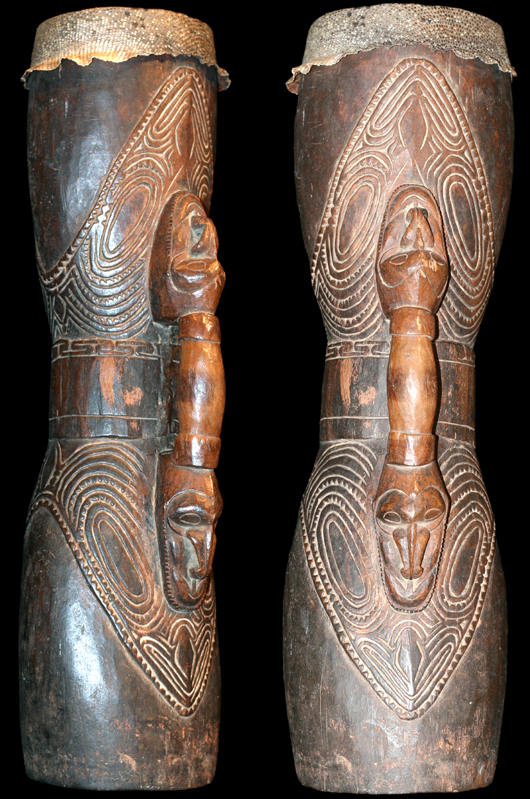
Ramu / Sepik Area Drum (New Guinea, Papua New Guinea)
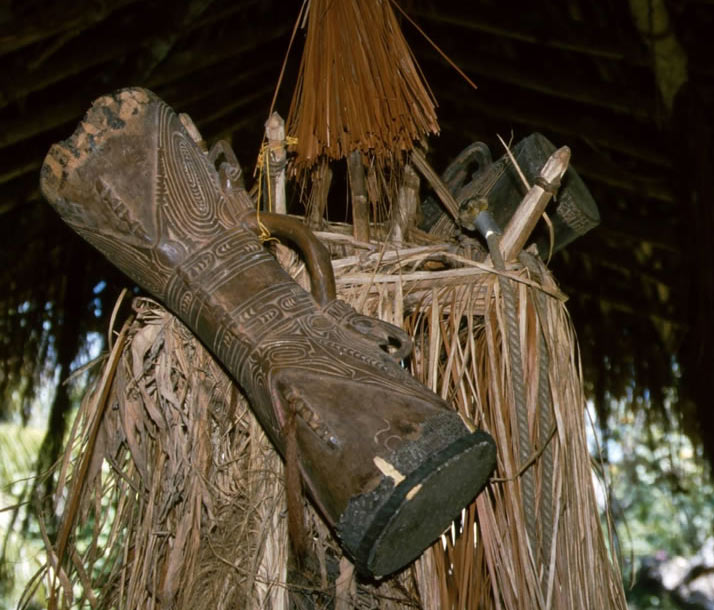
The drum belongs to the traditional musical culture of the Sepik and Ramu River regions of New Guinea, where drums have long formed an essential part of ceremonial and communal performance. Kundu drums accompany dances, songs, ritual gatherings and other important social occasions, providing both rhythmic structure and a means through which ancestral traditions are expressed.
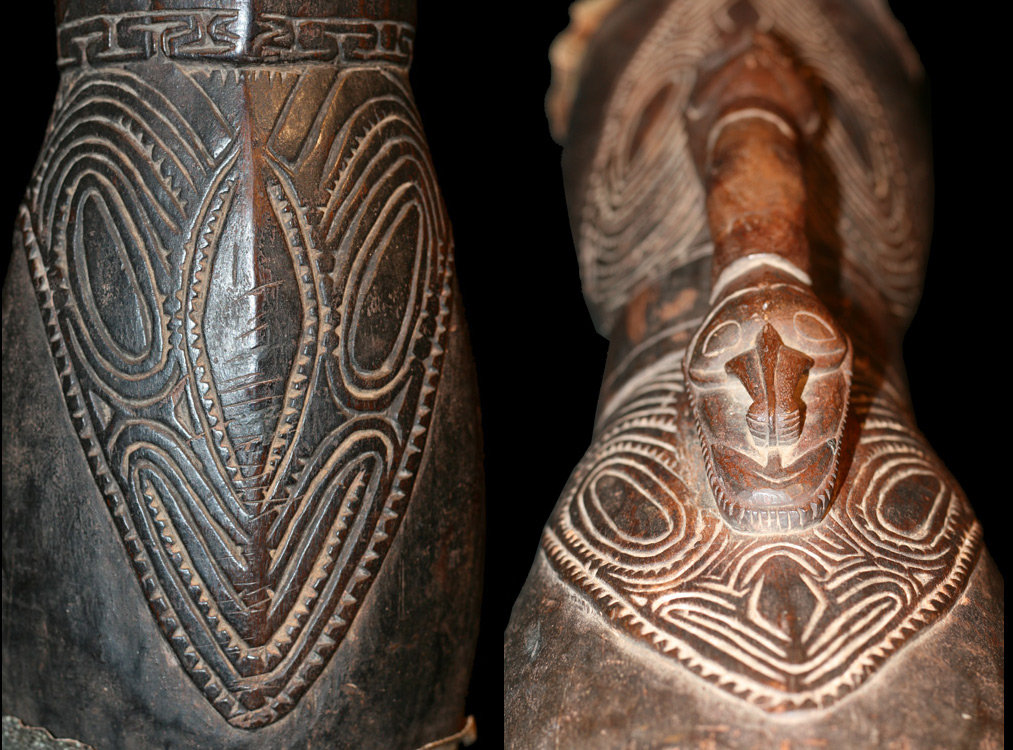
The present example is particularly remarkable for its sculptural handle, which terminates in two carved ancestral faces with elongated, beak-like noses. The figures are integrated directly into the body of the instrument rather than being applied as separate elements. Together with the surrounding incised ornament, they transform the functional handle into an important element of the drum's visual and symbolic character.
The drum was carved from a substantial tree trunk and hollowed from within. Traditional drum manufacture in New Guinea required considerable technical skill. As described by Don Niles, a suitable log was hollowed by burning: a hole was opened at one end, hot embers were placed inside, and the burnt wood was repeatedly removed before the process was continued. The exterior was then gradually shaped and thinned to the required form. Particular care was necessary to prevent the wood from cracking during manufacture and drying.
The drumhead was traditionally prepared from animal skin. The skin was softened in water before being stretched over the opening and secured with adhesive made from a particular tree.
Tuning was also an integral part of drum making and performance. The membrane could be tightened by holding it close to a fire, while small pieces of beeswax, sometimes mixed with soot, could be placed on the drumhead to influence its vibration and tonal quality. Such adjustments were particularly important because changes in temperature and humidity could alter the tension of the skin.
The combination of sound-producing function and ancestral imagery is characteristic of the wider artistic traditions of the Sepik region. On this drum, the carved faces incorporated into the handle give particular emphasis to the relationship between the instrument and the ancestral world. The drum is therefore not merely a percussion instrument but also a sculptural object in which musical function, craftsmanship and ancestral representation are closely connected.
"The carver (always male) hollows out the drum by gouging a hole at one end, placing hot embers in it, and gently blowing on them to burn the wood. After a while the embers are removed and the burnt wood is scraped away. The embers are replaced and the process continues until one half of the drum is hollowed through."
Niles, Don. In: Invocando a los espíritus: instrumentos musicales de Indonesia y Oceanía en la colección Helena Folch.
Craig, Barry; Busse, Mark; Eoe, Soroi (2010): Living Spirits with Fixed Abodes – The Masterpieces Exhibition. Papua New Guinea National Museum and Art Gallery.
Fischer, Hans (1958): Schallgeräte in Ozeanien. Sound-producing Instruments in Oceania.
Martinez-Jacquet, Elena: Invocando a los espíritus: instrumentos musicales de Indonesia y Oceanía en la colección Helena Folch.