New Guinea
Schouten Islands Drum New Guinea
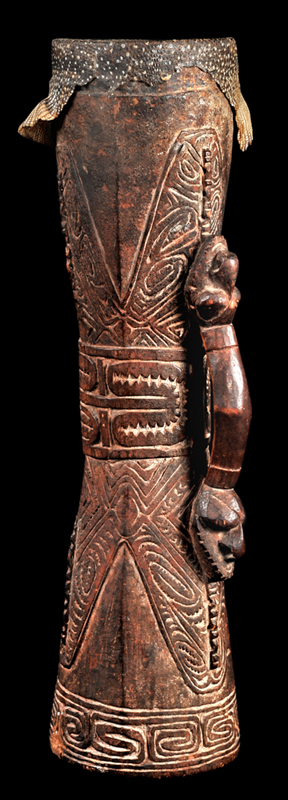
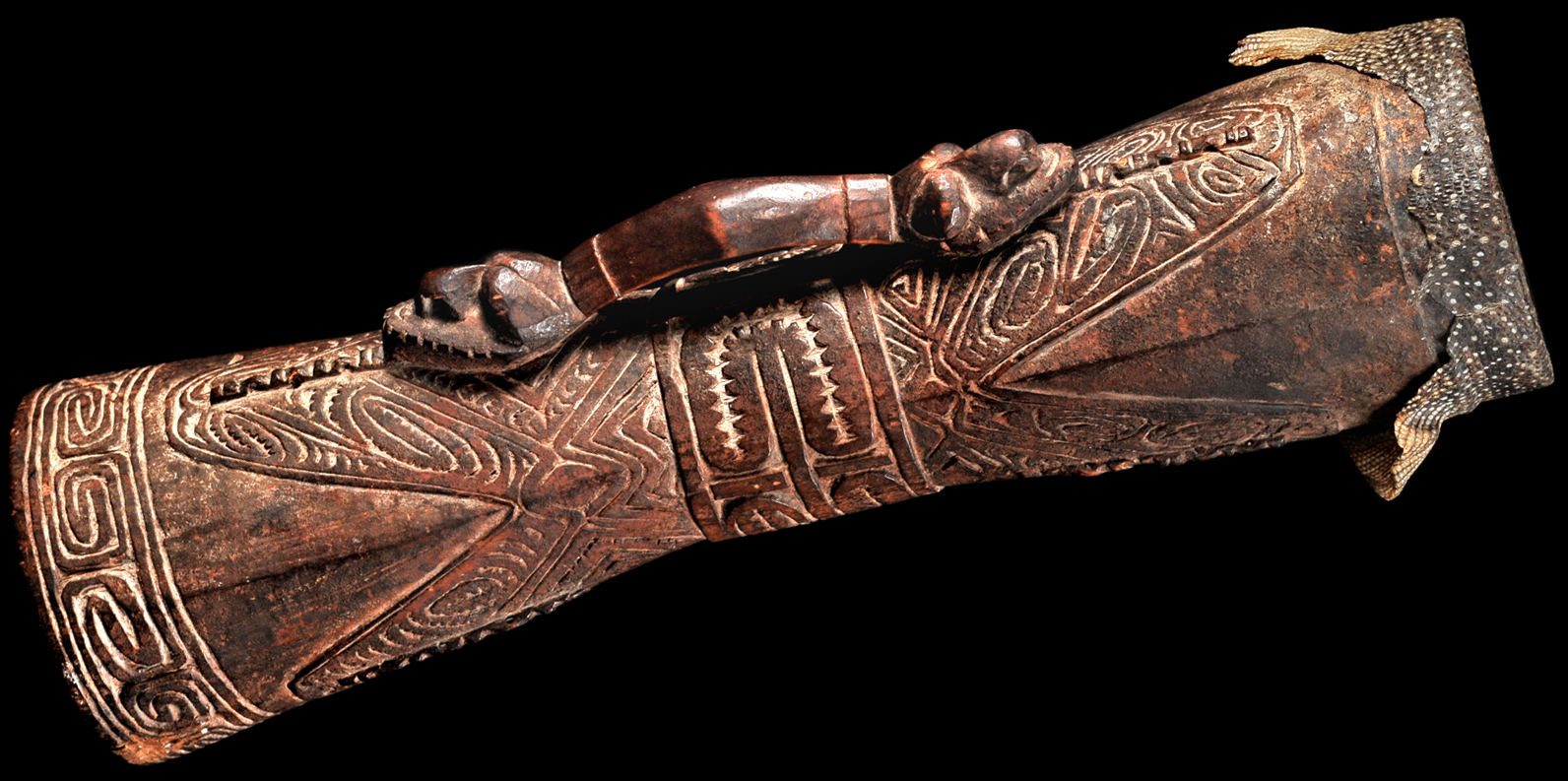
Schouten Islands Drum (Sepik Region, New Guinea, Papua New Guinea)
The present drum comes from the Schouten Islands, a group of islands situated off the northern coast of New Guinea in the wider Sepik region. Kundu drums from this area belong to a long-established tradition of ceremonial percussion and were used to accompany dances and other important communal and religious occasions. Museum collections contain several comparable drums from the Schouten Islands, demonstrating the distinctive combination of elongated hourglass-shaped bodies, carved handles and elaborate surface ornament characteristic of this region.
Particularly remarkable on the present example is the handle, which incorporates two finely carved ancestral faces. The faces are seated on opposite sides of the handle and are characterized by strongly elongated, beak-like noses. Their integration into the handle transforms what would otherwise be a purely functional element into an important sculptural component of the instrument. The treatment of the faces corresponds closely to the wider visual vocabulary of the Lower Sepik and the islands situated along its coastal margins.
The body of the drum is covered with deeply incised curvilinear ornament. A broad decorative band encircles the central section, from which larger tongue-shaped fields extend towards the two ends of the instrument. Within these fields, repeated flowing lines, spirals and interlocking motifs create a continuous rhythmic pattern. The decoration is not applied independently of the form but follows and emphasizes the changing contours of the drum body.
The drum was traditionally made from a solid section of wood. Comparable Schouten Islands drums were hollowed by controlled burning and scraping: a cavity was opened in a suitable log, hot embers were introduced and the charred wood was repeatedly removed until the interior had been sufficiently hollowed. The exterior was subsequently shaped and carved. This method required considerable technical skill, particularly because the wood had to be worked and dried without causing cracks in the resonator.
The drum is a single-headed membranophone. A reptile skin, traditionally lizard or snake skin, was stretched over one end of the wooden body to form the membrane. The instrument is held by its carved handle while the membrane is struck directly with the free hand. The tension of the skin could be adjusted by heating it near a fire, an important traditional method of maintaining the desired pitch under changing environmental conditions.
The sculptural treatment of the handle is especially significant because it establishes a direct visual relationship between the musical instrument and the ancestral imagery of the region. The two faces do not merely decorate the drum; they are incorporated into the point by which the instrument is held and played. In this way, the practical, acoustic and artistic dimensions of the object are united within a single carved form.
Comparable Kundu drums from the Schouten Islands are documented in museum collections. They are described as wooden drums used for religious and ceremonial dances, made by fire-hollowing and scraping the interior of a log, with reptile skin stretched over one end and carved or zoomorphic handles incorporated into the body.
Bowers Museum, Collection: Drum (Kundu), Schouten Islands, Sepik River Region, East Sepik Province, Papua New Guinea.
Craig, Barry; Busse, Mark; Eoe, Soroi (2010): Living Spirits with Fixed Abodes – The Masterpieces Exhibition. Papua New Guinea National Museum and Art Gallery.
Fischer, Hans (1958): Schallgeräte in Ozeanien. Sound-producing Instruments in Oceania.
Martinez-Jacquet, Elena: Invocando a los espíritus: instrumentos musicales de Indonesia y Oceanía en la colección Helena Folch.