New Guinea
Sepik Area Drum New Guinea
Sepik Area Drum (New Guinea, Papua New Guinea)
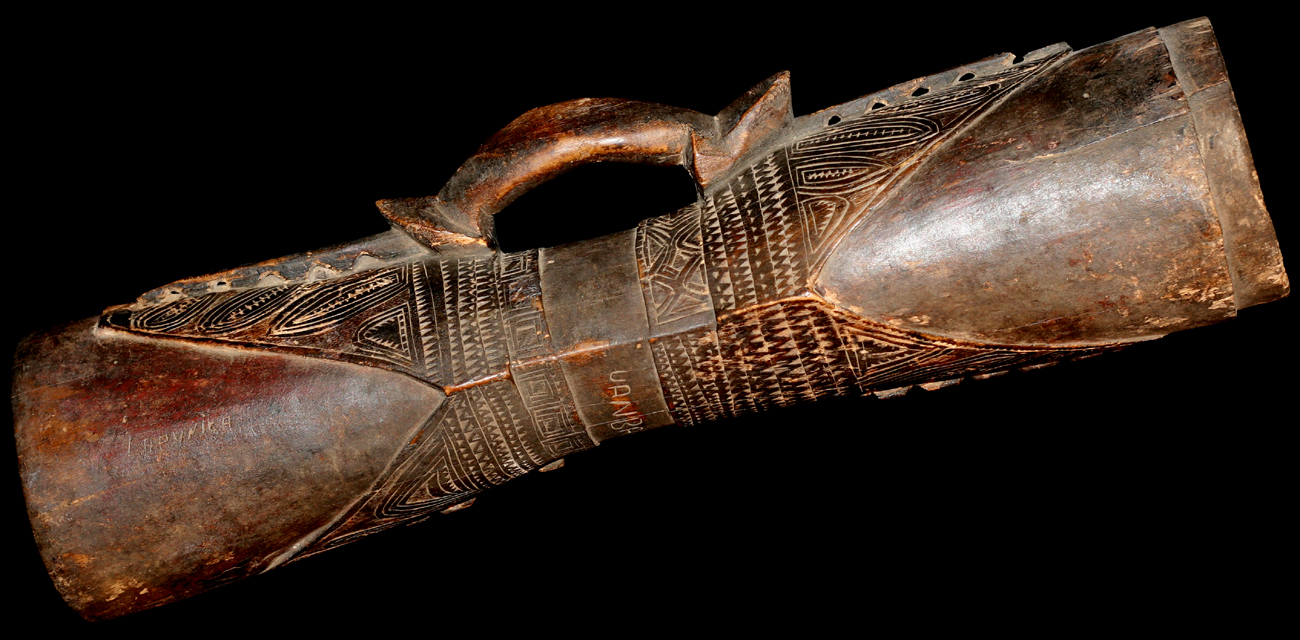
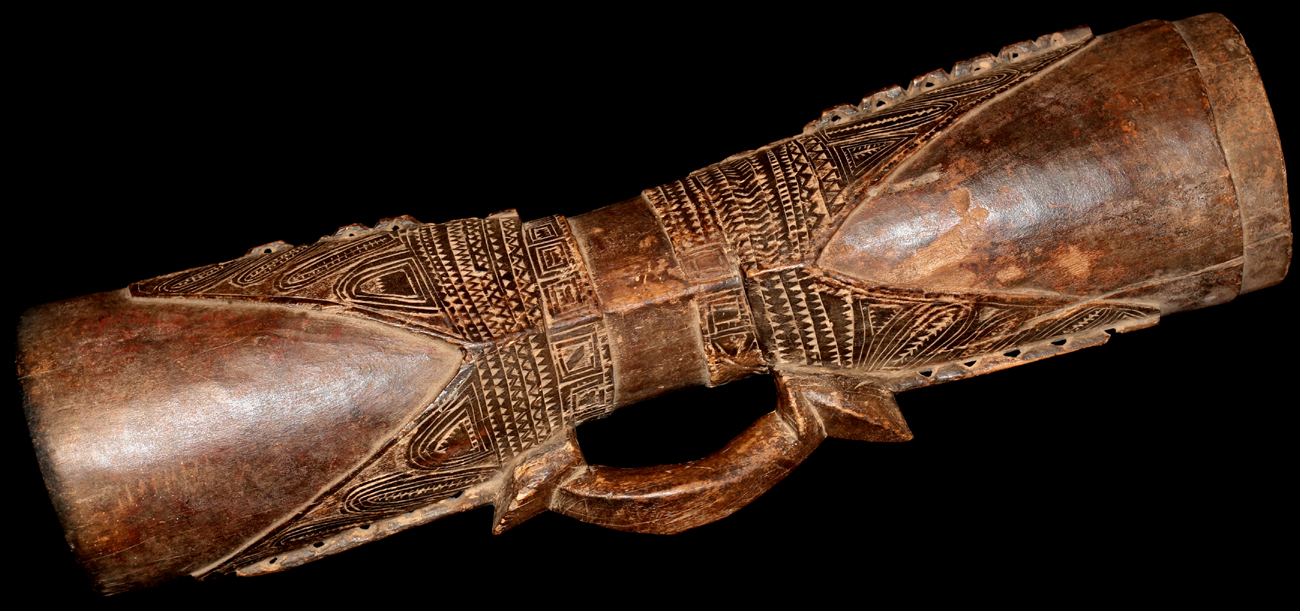
This Kundu drum from the Sepik region is distinguished by its strongly sculptural form and extensive incised decoration. The hourglass-shaped body expands broadly towards both ends and narrows markedly at the centre. A substantial carved handle is integrated into the waist of the drum, allowing the instrument to be held securely during performance.
The central section is densely covered with deeply incised geometric and curvilinear patterns. Triangular fields, parallel lines, stepped motifs and finely repeated cross-hatched elements are arranged in carefully defined bands and panels. The decoration follows the structure of the drum body and emphasizes the transition between the narrow waist and the two enlarged resonating chambers.
Particularly characteristic is the treatment of the handle and its surrounding area. The handle is formed as a continuation of the carved body rather than as an attached element, while pointed projections at either side create a pronounced sculptural silhouette. The combination of the functional handle, the strongly articulated waist and the extensive surface carving gives the instrument a distinctly three-dimensional character.
Kundu drums are carved from a solid piece of wood and traditionally hollowed by a slow burning process. The wood must dry gradually to reduce the risk of cracking, making the production of a large drum a time-consuming process that may extend over several weeks or months.
The drum is a single-headed membranophone. It is held in one hand while the other hand strikes the lizard-skin membrane. Traditional drums may be tuned by heating the drumhead over a fire; small pieces of beeswax can also be applied to the membrane to modify its sound.
Throughout the Sepik region, drums are important instruments in ceremonial and communal music. They accompany dances, songs, festivals and other major occasions, where drumming forms part of a broader tradition of musical and ritual performance.
Bibliography:
Craig, Barry; Busse, Mark; Eoe, Soroi (2010): Living Spirits with Fixed Abodes – The Masterpieces Exhibition. Papua New Guinea National Museum and Art Gallery.
Fischer, Hans (1958): Schallgeräte in Ozeanien. Sound-producing Instruments in Oceania.
Martinez-Jacquet, Elena: Invocando a los espíritus: instrumentos musicales de Indonesia y Oceanía en la colección Helena Folch.