New Guinea
Siassi / Huon Gulf drum New Guinea
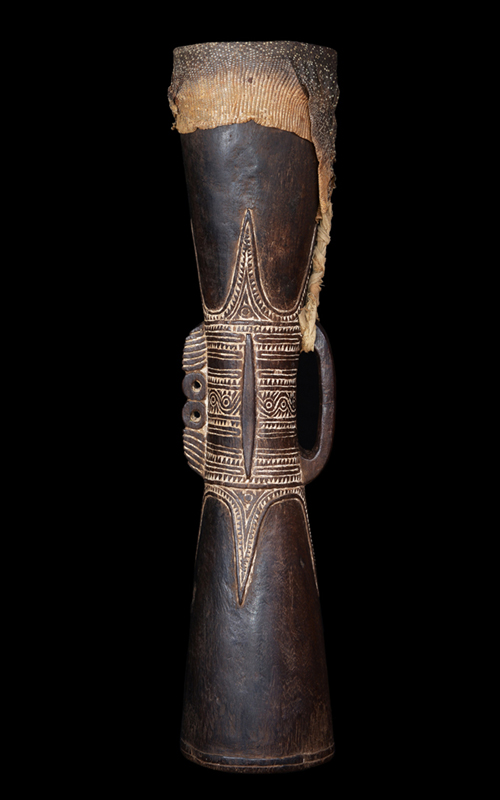
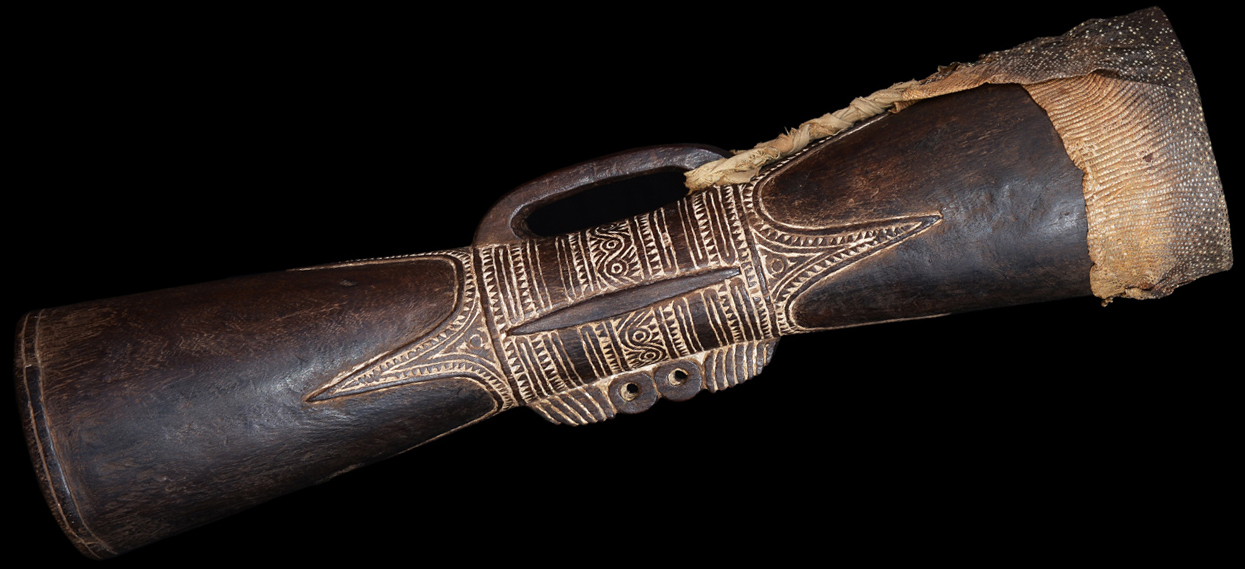
Siassi Island Drum (Huon Gulf, Papua New Guinea)
The drums of the Huon Gulf form a distinctive regional tradition within the musical and artistic cultures of northeastern New Guinea. Their characteristic hourglass-shaped bodies, narrowing at the centre and expanding towards both ends is typical drums found in Papua New Guinea. The artistic traditions of the Huon Gulf also show strong connections with those of the neighbouring Astrolabe Bay area.
The surface is extensively decorated with deeply incised and engraved patterns. The ornament is concentrated particularly around the central waist, where a broad decorative zone extends across the body and is continued by elongated motifs towards the upper and lower ends. The composition is based on repeated curves, parallel lines, pointed forms and geometric elements, creating a highly ordered surface design.
Such motifs belong to a wider artistic vocabulary of the Huon Gulf. Ralph Linton noted that commonly used designs in carvings from the region included wavy or snake-like zigzags, sharp-toothed patterns, and concentric parallel lines. White pigment was traditionally rubbed into the incised surfaces, emphasising the patterns and giving the carved ornament a strong visual contrast.
The decoration of the central waist has been given particular attention in descriptions of Huon Gulf drums. Tibor Bodrogi recorded that, according to the craftsmen consulted by Biró, the designs on the waist of the drum represented bracelets and motifs associated with bracelets. From this central area, additional motifs extend towards the two openings, integrating the ornament with the characteristic structure of the instrument.
The handle of Huon Gulf drums is generally formed as a simple open arc, either flat or cylindrical and varying in length. In contrast to the relatively plain handle, the body opposite it may carry elaborate carved and engraved decoration. This distinction between the functional handle and the richly ornamented body is clearly visible on the present example.
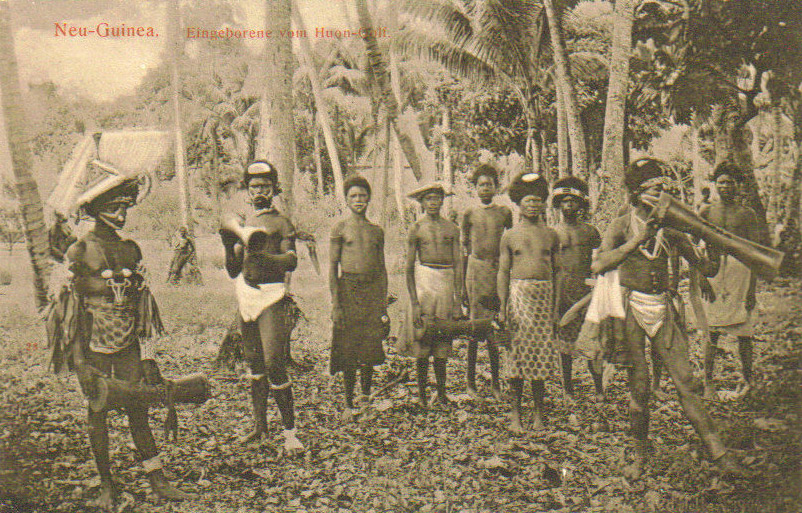
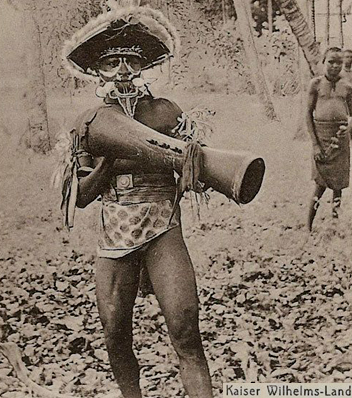
Historical photographs provide valuable comparative evidence for the form and use of Huon Gulf drums. Early twentieth-century photographs show men carrying and playing drums with closely related hourglass-shaped bodies and open handles. Such images document the presence of these instruments within the social and ceremonial life of communities in the region.
"The motifs most commonly used in all types of carvings from the Huon Gulf include a wavy, snake-like zig-zag, a sharp-toothed design, and concentric parallel lines. White is practically always rubbed into the surface patterns."
Ralph Linton, Arts of the South Seas. The Museum of Modern Art, distributed by Simon & Schuster, 1946.
Bibliography:
Bodrogi, Tibor (1961): Art in North-East New Guinea. Budapest: Hungarian Academy of Science.
Dark, Philip J. C. (1974): Kilenge Art and Life. London: Academy.
Linton, Ralph (1946): Arts of the South Seas. The Museum of Modern Art, distributed by Simon & Schuster.
Craig, Barry (Ed.): Living Spirits with Fixed Abodes.