New Guinea
Telefomin Area Drums New Guinea
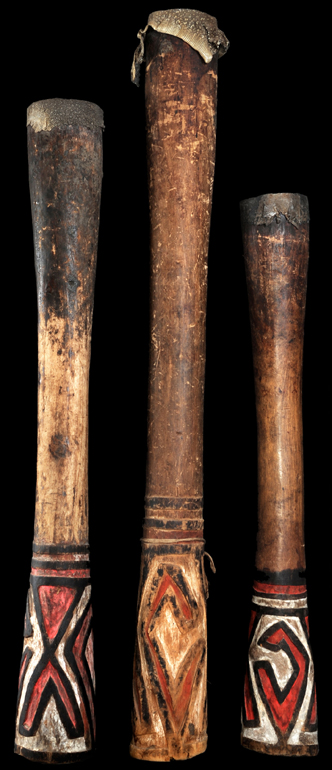
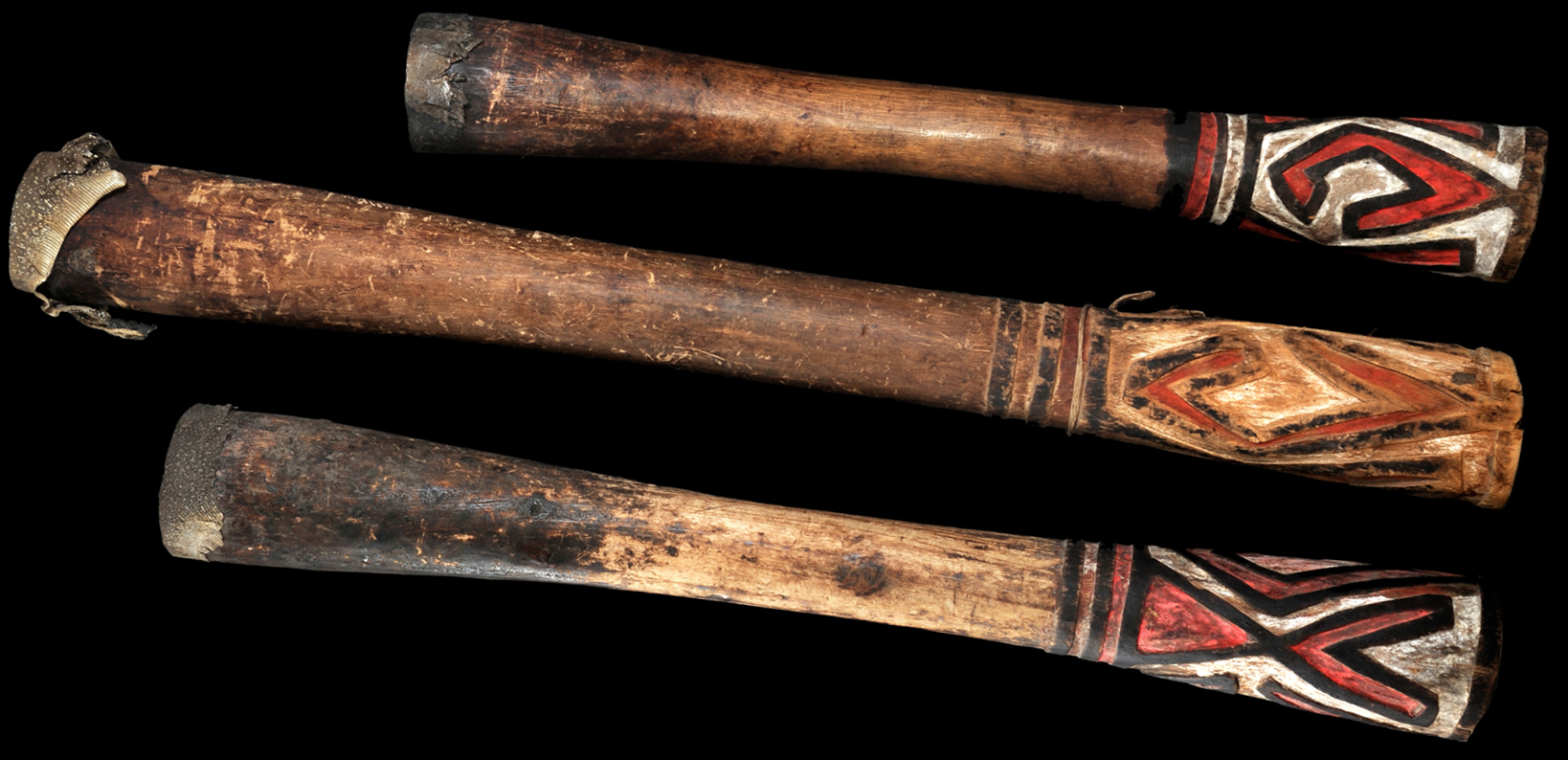
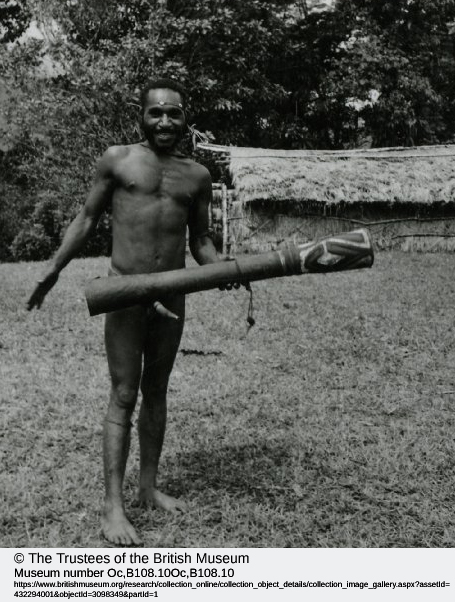
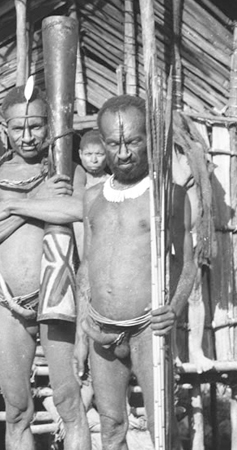
Telefomin Area Drums (ot/wos)(Sandaun Province, Papua New Guinea)
This hand drum belongs to the drum tradition of the Mountain-Ok peoples of the western highlands of Papua New Guinea. Among the Telefomin, some drums were made locally, while many were obtained from the Atbalmin to the west, who specialized in their manufacture. Despite this circulation, the basic design remained consistent throughout the Mountain-Ok region.
The drumhead is traditionally made from lizard skin, stretched tightly over the upper end of the wooden body and fixed with tree sap. Small lumps of beeswax are pressed onto the membrane to improve its tone. At the lower end, Mountain-Ok drums carry a carved and painted design in red, white and black. Barry Craig notes that this design is essentially identical throughout the Mountain-Ok area, although the meanings attributed to individual elements may differ between groups.
Among the Telefomin, the designs used on drums form part of a wider visual vocabulary also found on houseboards and shields. The decoration of the drum is therefore closely connected with the broader artistic traditions of the region rather than functioning simply as surface ornament.
The drum also has an important musical and initiatory function. Among Telefol speakers and other Min groups, young men traditionally learn to play the drum during the fifth of seven stages of initiation, known as wotban. The drum itself is not secret; rather, the knowledge of how to play it, and the cultural significance attributed to its playing and sound, is transmitted through initiation. This knowledge connects the drum with cultural heroes, taro, death, maggots, decay and fertility.
The Telefomin drum thus combines a standardized regional form with a system of visual and musical knowledge transmitted within Mountain-Ok society. Its carved decoration, playing technique and role in initiation demonstrate the close relationship between material culture, music and ritual knowledge in the region.
"Not all Mountain-Ok groups make the hourglass-shaped hand-drums (ot/wos); some import them from those who specialise in their manufacture. For example, although a few Telefomin make their own drums, most are imported from the Atbalmin to the west. Nevertheless, the design is the same throughout the area.
The Tympanum is formed from the skin of a lizard streched tightly over the proximal end of the drum and glued into place with the sap of a tree.
Small lumps of beewax are pressed onto the skin to improve its tone. At the distal end, a design is carved and painted with red, white and black paint.
The design is identical for all the Mountain-Ok groups but the meanings of the design elements may vary.
The Telefomin provide meanings identical to similar motifs on houseboards and shields."
Barry Craig (1988), Art and Decoration of Central New Guinea, p. 53.
"(...)among Telefol speakers and other Min groups, males in their twenties learn how to drum at the fifth of seven stages of initiation, called wotban. While the drum (wot) itself is not secret, knowledge to play it is learned through ritual, where the relation of the instrument, its playing, and its sound to cultural heroes, taro, death, maggots, decay, and fertility can only be taught through initiation (Brumbaugh 1979:240–41, 368–75; 1990)."
Excerpt from: Weiner, James F. and Niles, Don (2015), Songs of the Empty Place – The Memorial Poetry of the Foi of the Southern Highlands Province of Papua New Guinea, p. XXXIII.
Bibliography:
Brumbaugh, Robert (1980): "Models of Separation and a Mountain Ok Religion." Ethos 8 (4): 332–348.
Cranstone, B. (1968): "War shields of the Telefomin sub-district, New Guinea." Man 3.
Craig, Barry (1988): Art and Decoration of Central New Guinea. Shire Publications Ltd.
Weiner, James F. and Niles, Don (2015): Songs of the Empty Place – The Memorial Poetry of the Foi of the Southern Highlands Province of Papua New Guinea.