New Guinea
Torres Strait Islands Drum New Guinea
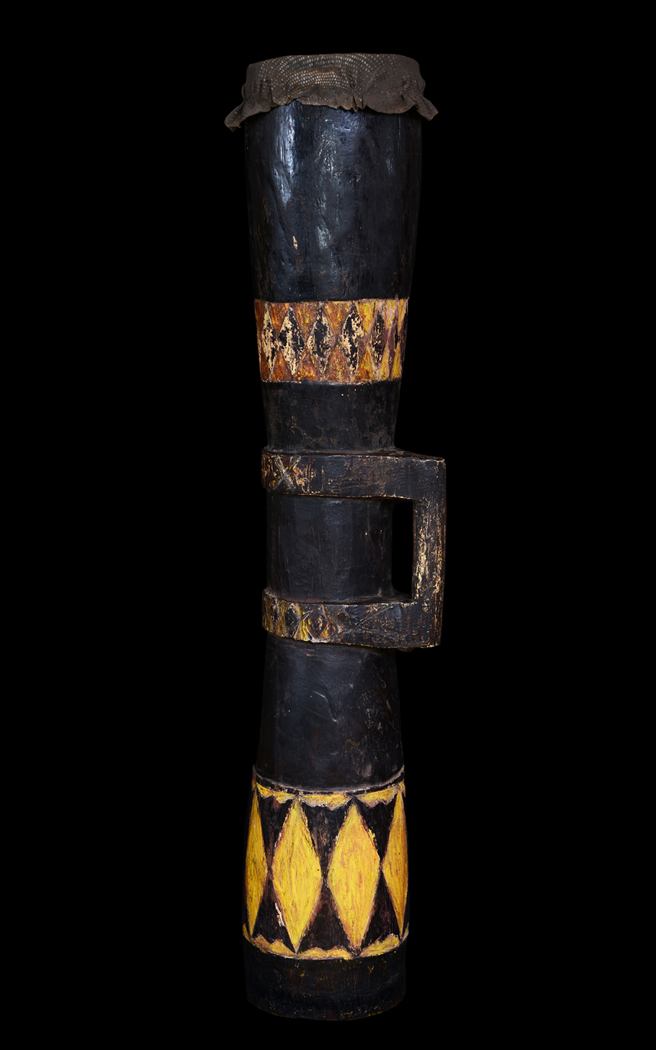
Torres Strait Islands Drum (Torres Strait Region, Papua New Guinea)
This hand drum belongs to the drum tradition of the Torres Strait Islands and the adjacent mainland region of southern New Guinea. Drums of this type have long been important instruments in Torres Strait Islanders dance and other performances.
David Lawrence notes that drums of this type originated in villages situated in the well-wooded inland regions around the headwaters of the Pahoturi, Binaturi and Oriomo Rivers. From these mainland areas the drums became widely used throughout the Torres Strait. Their characteristic form and construction therefore represent a regional tradition extending across the cultural connections between southern New Guinea and the Torres Strait islands.
The geometric decoration is particularly characteristic of these drums. Lawrence describes carved diamond and triangular patterns at the base, with the designs commonly repeated around the handle boss. On the present example, these geometric forms are preserved as decoration, creating a strong contrast against the darkened wooden surface.
The drum is a single-headed membranophone, played as a hand-held instrument during dance and performance. Torres Strait Islanders traditionally used wild beeswax, known as isau, to adjust the tension and sound of the drumhead. The continued importance of these drums is also reflected in their modern use by dance groups, where older instruments may be recarved and repainted.
"Drums of this type, now used throughout the Torres Strait, originate from the villages located in the well-wooded inland region at the headwaters of the Pahoturi, Binaturi and Oriomo rivers. Waisted drums from the inland region all have handles carved from the same piece of timber as the body of the drum. They are generally about one metre in length with an even symmetrical shape, decorated at the base with carved diamond and triangular patterns. These carvings are usually repeated around the handle boss. At the present time these drums are used by most Torres Strait Islander dance groups both on the Australian mainland and in the islands although they are often recarved and overpainted with bright acrylic paint which adds to their visual impact during competitive dance performances. Drums have been, and still are, important items of material culture in the Torres Strait and Fly estuary region. Perhaps the reason for this is that no readily transportable, functional substitute has been found that could reproduce the quality of sound and visual impact of the wooden hand drum."
David Lawrence, Gunnar Landtman in Papua: 1910 to 1912. With assistance from Pirjo Varjola. Canberra: ANU Press, 2010.
Bibliography:
Lawrence, David (2010): Gunnar Landtman in Papua: 1910 to 1912. With assistance from Pirjo Varjola. Canberra: ANU Press.
Landtman, Gunnar (1927): The Kiwai Papuans of British New Guinea. London.
Williams, F. E. (1935): Papuans of the Trans-Fly. Oxford.
Landtman, Gunnar (1917): The Folk-Tales of the Kiwai Papuans. Acta Societatis Scientiarum Fennicae XLVII. Helsingfors.
Haddon, A. C. (1935): Reports of the Cambridge Anthropological Expedition to Torres Straits. Vol. 1. Cambridge.
Craig, Barry (Ed.): New Guinea Art: Masterpieces of the Jolika Collection from Marcia and John Friede.