New Guinea
Wakde Island Drum New Guinea
Wakde Island Drum (Humboldt Bay, West Papua)
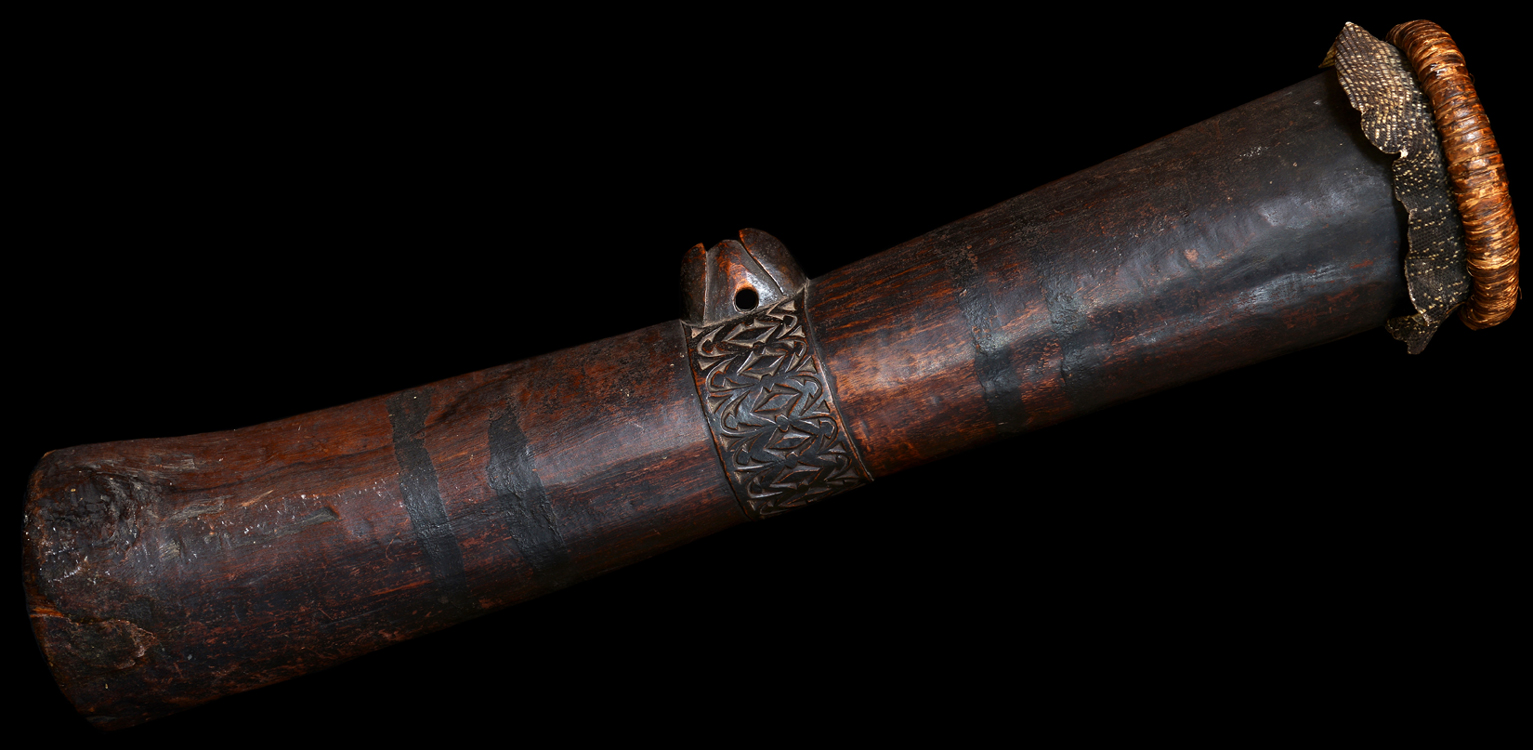
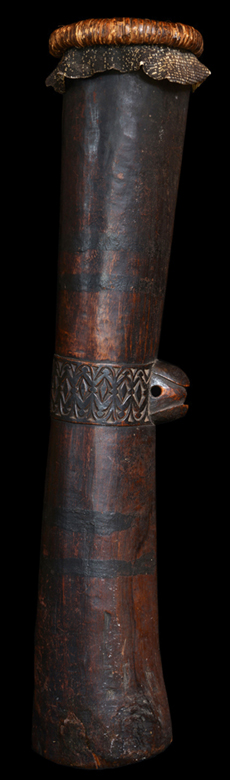
This large ceremonial drum is attributed to the Humboldt Bay region of West Papua, probably Wakde Island. Its elongated wooden body narrows a bit at the centre, where a broad carved band forms the principal area of decoration. The drum has a varanus skin and a distinctive zoomorphic projection incorporated into the central section.
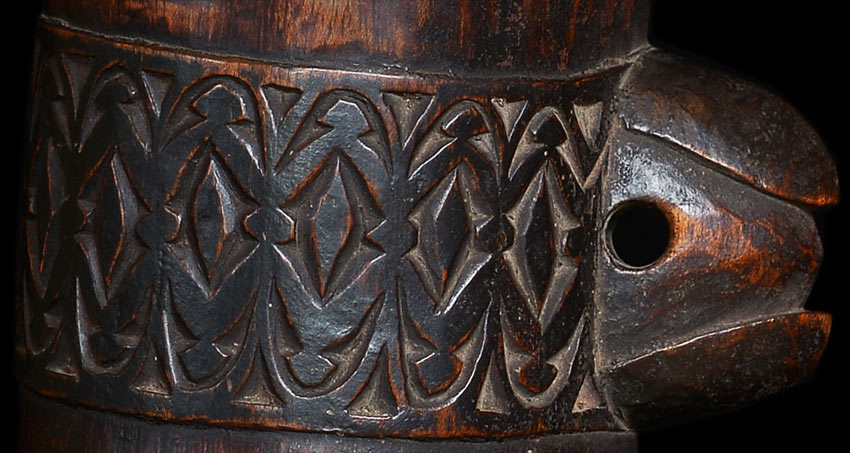
The central band is carved in relief with highly stylized human or animal figures. Interlocking arms and legs form two continuous zigzag patterns that encircle the body. The figures are not fully naturalistic, and their precise meaning is not known. They have sometimes been interpreted as frog-like forms; in the local terminology cited by Kooijman and Hoogerbrugge, the combination of human and frog imagery may be referred to as karkarau, a term associated with both the human figure and the frog.
The encircling relief may also be understood as resembling a belt or girdle. The source literature suggests a possible analogy with the hip bands worn by chiefs, which were regarded as possessing protective power. This interpretation remains tentative, as the precise significance of the carved motifs is not securely documented.
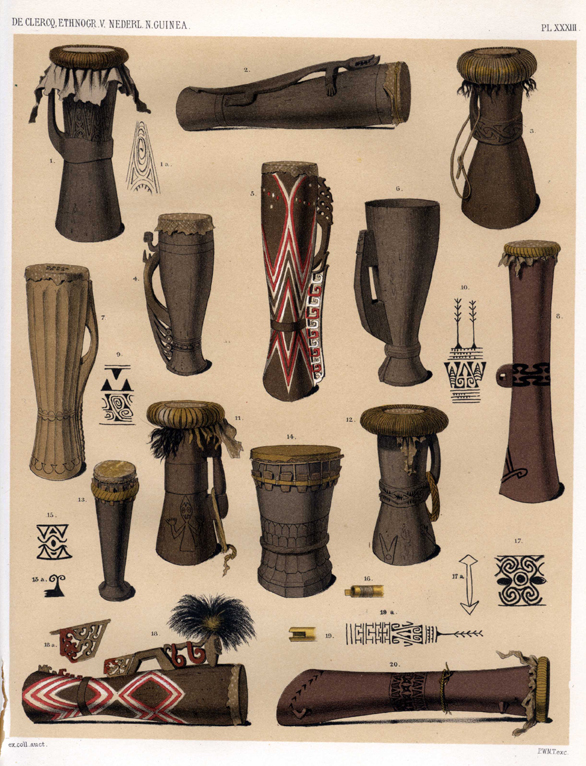
Large ceremonial drums were part of the men's house, or mau, and played a role in initiation rituals. They provided rhythmic accompaniment for dances and songs. As in many regions of New Guinea, the sound of the drum was understood not simply as music but as the voice of ancestors or other beings of the spirit world. In Humboldt Bay, this perceived connection between sound and the supernatural world was considered fundamental to the value of the drum.
“The central part (the manchet) of the drum is decorated with figures carved in relief in the wood. These figures consist of stylized human or animal figures. The interlocking and merging arms and legs form two continuous zigzag bands. The meaning of these figures is not known. If an animal figure is represented, it should presumably be understood as a frog. The combination of human and animal can then be designated as ‘karkarau’, a word that refers to both the human figure and the frog (Kooijman and Hoogerbrugge 1992:77). The band-shaped decoration around the centre of the drum may perhaps be regarded as a belt with protective power, analogous to the hip band worn by the chief.”
Kooijman, S. and Hoogerbrugge, J. (1992), in Greub, S. (ed.), Art of Northwest New Guinea: From Geelvink Bay, Humboldt Bay, and Lake Sentani. New York: Rizzoli.
Bibliography:
Collaer, P. (1965): Musikgeschichte in Bildern – Ozeanien. Leipzig.
Greub, S. (ed.) (1992): Art of Northwest New Guinea: From Geelvink Bay, Humboldt Bay, and Lake Sentani. New York: Rizzoli.
Webb, Virginia-Lee (2011): Ancestors of the Lake – Art of Lake Sentani and Humboldt Bay, New Guinea. Houston: The Menil Collection, Menil Foundation.