New Guinea
Yangoru Boiken Drum New Guinea
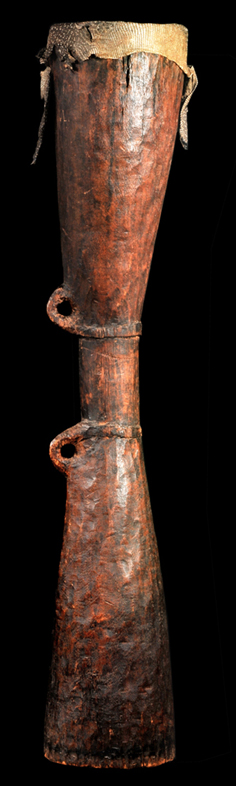
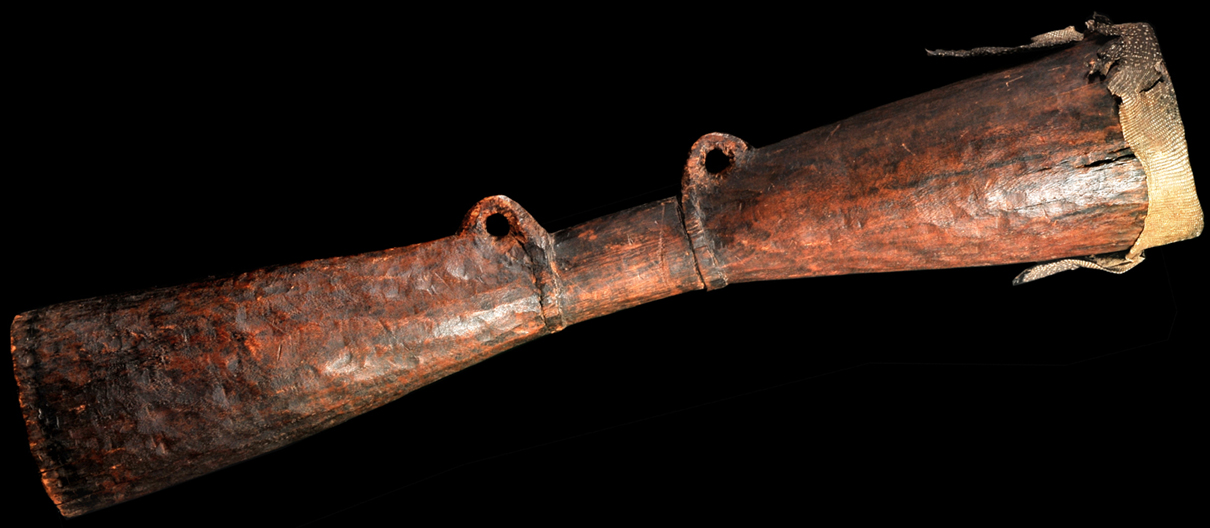
Yangoru Boiken "Flute-Playing Drum", Pre Contact,(East Sepik Province, Papua New Guinea)
This distinctive hand drum comes from the Yangoru area of the Boiken people, who live on the southern slopes of the Prince Alexander Mountains in East Sepik Province. It belongs to a specialized form of hand drum that was played together with a long bamboo instrument by the same musician.
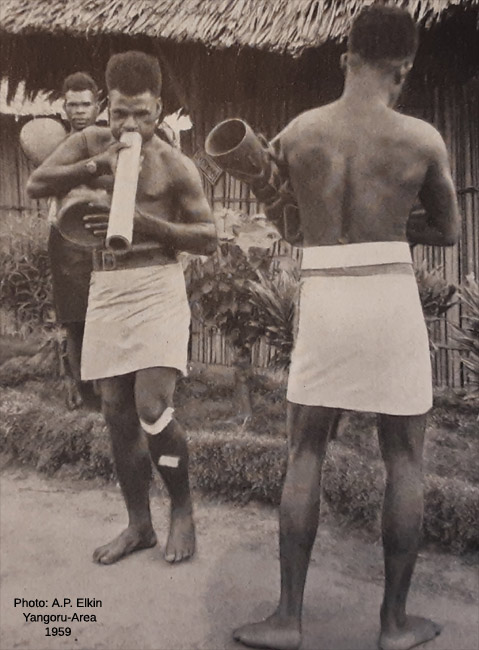
The term “flute-playing drum”, used in the literature for this type of Yangoru Boiken drum, should be questioned in the light of the historical photograph. The bamboo instrument shown is not a flute in the conventional sense. It has no visible finger holes for altering the pitch, and the way it is held makes the use of finger holes impossible. Its construction and playing position therefore do not support its classification as a flute.
The instrument appears instead to have been a simple bamboo tube played by blowing or speaking into it, probably in a manner comparable to the Australian didgeridoo. It may have produced a fundamental tone that could be varied through changes in the player's breath, voice and embouchure, with overtones generated and emphasized in a similar way. The designation “flute-playing drum” is therefore retained here only as a term established in the literature; the instrument depicted is more plausibly understood as a bamboo tube used as a drone or overtone-producing wind instrument.
The drum has a waisted hourglass-shaped body with two projecting lugs through which a rattan shoulder strap could be attached. Suspended from the strap, the instrument could be held and struck with one hand while the player simultaneously sounded the bamboo instrument.
The body was carved and hollowed from a single piece of wood. Its elongated proportions and narrow waist allow the drum to be carried comfortably while playing. The surface is darkened through age and use, while a narrow carved band around the waist forms the principal ornamental element. The drum was made with traditional tools, including stone tools, before the widespread introduction of metal tools.
The musical practice documented for the Yangoru area illustrates the remarkable coordination of percussion and wind instrument in Boiken music. Rather than functioning as an isolated percussion instrument, the drum was part of a combined performance in which the rhythmic pulse of the hand drum accompanied the sound of the bamboo instrument.
The historical photograph from the Yangoru area, dated 1959 and photographed by A. P. Elkin, provides valuable visual evidence for the continued use of comparable drums in performance. It shows the instrument carried against the body while a long bamboo instrument is played at the same time.
Bibliography:Craig, Barry (ed.) (2011): Living Spirits with Fixed Abodes: Anthropology, Art and the Colonial Experience in New Guinea and the Solomon Islands. Honolulu: University of Hawai‘i Press.
Collaer, Paul: Musikgeschichte in Bildern – Ozeanien. Leipzig: VEB Deutscher Verlag für Musik.
Friede, John and Marcia (2005): New Guinea Art – Masterpieces of the Jolika Collection. San Francisco.
Hamson, Michael (2011): Art of the Boiken.